Reseller Hosting
46 Essential Things You Should Know About Reseller Hosting in 2026
46 Things You Should Know About Reseller Hosting Have you ever dreamed of starting your own online business? Many entrepreneurs, freelancers, web designers, developers, and digital agencies look for opportunities that generate recurring income…

46 Things You Should Know About Reseller Hosting
Have you ever dreamed of starting your own online business? Many entrepreneurs, freelancers, web designers, developers, and digital agencies look for opportunities that generate recurring income without requiring massive investments. Unfortunately, most business ideas require significant capital, technical expertise, office space, or a large team before they become profitable.
Reseller hosting is different.
With reseller hosting, you can start your own web hosting business without purchasing expensive servers, managing data centers, or hiring a team of server administrators. Instead, you leverage the infrastructure of an established hosting provider and sell hosting services under your own brand.
As more businesses, startups, bloggers, eCommerce stores, and professionals move online, the demand for reliable web hosting continues to increase. Every website needs hosting, email services, SSL certificates, backups, and technical support. This growing demand creates an excellent opportunity for entrepreneurs to build a recurring revenue business through reseller hosting.
Whether you’re a web designer looking to offer complete website solutions, a developer wanting to add hosting services to your portfolio, or an entrepreneur seeking a scalable online business model, reseller hosting can help you generate long-term recurring income.
However, before launching your reseller hosting business, it’s important to understand the fundamentals. Choosing the right provider, understanding hosting technologies, creating attractive hosting packages, and learning how to market your services are all critical to success.
In this guide, we’ll cover the 46 Things You Should Know About Reseller Hosting you should know before starting a reseller hosting business.
What Is Reseller Hosting?
Reseller hosting is a web hosting service that allows you to purchase hosting resources from a hosting provider and resell those resources to your own customers under your own brand.
In simple terms, you become a hosting provider without owning servers.
The parent hosting company manages:
- Server infrastructure
- Hardware maintenance
- Network management
- Security updates
- Technical backend operations
You focus on:
- Acquiring customers
- Managing hosting accounts
- Building your brand
- Growing your business
This makes reseller hosting one of the most accessible ways to enter the web hosting industry.
Why Is Reseller Hosting Important?
Reseller hosting has become increasingly popular because businesses today prefer complete solutions.
For example, if you’re a web designer and build a website for a customer, that customer also needs:
- Web Hosting
- Business Email
- SSL Certificate
- Domain Management
- Technical Support
Instead of sending clients to another hosting provider, reseller hosting allows you to provide everything under one brand.
This creates:
- Better customer experience
- Additional revenue streams
- Stronger client relationships
- Increased business credibility
- Recurring monthly and yearly income
For web designers, developers, digital agencies, and IT consultants, reseller hosting can significantly increase profitability.
Choosing the Right Hosting Provider
Selecting the right reseller hosting provider is one of the most important decisions you’ll make.
The quality of your hosting provider directly impacts your business reputation, customer satisfaction, and long-term growth.
1. Understand Your Hosting Requirements
Before purchasing any reseller hosting plan, determine your business requirements.
Ask yourself:
- How many clients do you plan to host?
- What type of websites will they run?
- How much storage will be required?
- What level of support will they expect?
Understanding your requirements helps you select a plan that aligns with your business goals while avoiding unnecessary expenses.
2. Check Uptime Reliability
Website downtime can damage customer trust and affect business operations.
A reliable reseller hosting provider should maintain high uptime levels and stable infrastructure.
When evaluating providers, review their uptime guarantees and reputation.
A provider with consistent uptime helps ensure that customer websites remain accessible around the clock.
3. Understand Renewal Pricing
Many hosting companies advertise attractive introductory prices.
However, renewal pricing can be significantly higher.
Before committing to any reseller hosting plan, review:
- Initial pricing
- Renewal pricing
- Upgrade costs
- Additional fees
Understanding the complete pricing structure helps avoid surprises later.
4. Review Backup Policies
Backups are essential for website protection.
Data loss can occur because of:
- Hardware failures
- Human error
- Malware infections
- Software conflicts
Choose a reseller hosting provider that offers regular backups and clear recovery options.
A strong backup strategy can save both you and your customers from significant downtime.
5. Understand Account Limitations
Every reseller hosting plan includes specific resource allocations and usage policies.
Review:
- Disk space limits
- Bandwidth limits
- CPU usage policies
- Email account limits
- Inode limits
Understanding these restrictions helps prevent account suspensions and resource-related issues.
6. Evaluate Customer Support
Customer support is one of the most critical factors in reseller hosting.
Even if you’re experienced, there will be times when you need assistance with:
- Server issues
- Account problems
- DNS configurations
- Website migrations
Choose a provider that offers reliable support through:
- Live Chat
- Ticket System
- Email Support
- Phone Support
Strong support helps you resolve issues faster and maintain customer satisfaction.
7. Verify Money-Back Guarantees
A money-back guarantee provides additional confidence when choosing a hosting provider.
If the service doesn’t meet expectations, you should have the option to request a refund within the specified period.
Always review:
- Refund eligibility
- Refund duration
- Terms and conditions
This helps reduce risk when testing a new hosting provider.
Selecting the Best Reseller Hosting Company
Not all reseller hosting providers are the same.
Choosing the right company requires evaluating both technical capabilities and business-friendly features.
8. Look for Scalability
Your reseller hosting business may start small, but growth should always be part of the plan.
A good provider should allow you to:
- Upgrade resources easily
- Add more hosting accounts
- Expand storage and bandwidth
- Scale as customer demand increases
Scalability ensures your hosting business can grow without major disruptions.
9. Evaluate Value for Money
Price alone should never determine your decision.
Instead, compare:
- Storage
- Bandwidth
- Control panels
- Backup services
- Security features
- Support quality
The provider that offers the best combination of features and reliability often delivers the greatest value.
10. Understand Contract Terms
Before purchasing reseller hosting, review the provider’s contract terms.
Pay attention to:
- Billing cycles
- Renewal policies
- Cancellation procedures
- Upgrade policies
Understanding these details prevents future misunderstandings.
11. Analyze Profit Potential
Reseller hosting offers strong recurring revenue opportunities.
However, profitability depends on:
- Pricing strategy
- Customer acquisition
- Service quality
- Customer retention
The more customers you retain, the more predictable your recurring income becomes.
12. Understand Your Responsibilities
As a reseller, you become the primary point of contact for your customers.
Responsibilities include:
- Customer communication
- Account management
- Basic technical assistance
- Billing management
Providing excellent service helps build trust and long-term customer relationships.
13. Consider Server Locations
Server location affects website performance.
If your customers are located in India, hosting websites closer to Indian users can improve loading speeds.
However, if you serve international customers, choosing a provider with multiple data center locations offers greater flexibility.
14. Research Provider Reputation
Before selecting a reseller hosting provider, research their reputation.
Review:
- Customer testimonials
- Industry reviews
- Support experiences
- Company history
A provider with a strong reputation is more likely to support your long-term business success.
15. Choose a Provider That Supports Your Brand
One of the biggest advantages of reseller hosting is white-label branding.
Your hosting provider should allow you to:
- Use your own company name
- Create custom hosting packages
- Configure private nameservers
- Build your own hosting brand
White-label functionality helps establish credibility and professionalism.
Setting Up a Reseller Hosting Business
Once you’ve selected a reliable reseller hosting provider such as WebyStrata, the next step is setting up your hosting business properly.
This stage involves selecting the right hosting platform, understanding management tools, configuring your brand, and preparing your business infrastructure.
16. Choose Between Linux and Windows Reseller Hosting
One of the first decisions you’ll make is selecting the hosting platform.
Most reseller hosting providers offer:
Linux Reseller Hosting
Linux hosting is the most popular option due to its flexibility, stability, and compatibility with popular applications such as:
- WordPress
- Joomla
- Drupal
- Magento
- WooCommerce
- OpenCart
Linux reseller hosting typically includes:
- cPanel
- WHM
- Softaculous
- MySQL Databases
- PHP Support
For most businesses and website owners, Linux reseller hosting is the preferred choice.
Windows Reseller Hosting
Windows hosting is designed for websites and applications that require:
- ASP.NET
- MSSQL Databases
- Windows-specific technologies
Windows hosting generally includes the Plesk control panel.
Unless your customers specifically need Microsoft technologies, Linux hosting is usually the better option.
17. Understand cPanel
cPanel is one of the most widely used web hosting control panels.
Your customers will use cPanel to manage their websites.
With cPanel, users can:
- Create email accounts
- Manage files
- Install applications
- Create databases
- Configure backups
- Manage domains
A user-friendly control panel improves customer satisfaction and reduces support requests.
18. Learn WHM (Web Host Manager)
WHM is the management interface used by reseller hosting providers.
WHM allows you to:
- Create customer accounts
- Assign hosting packages
- Manage resources
- Suspend accounts
- Upgrade plans
Think of WHM as the control center for your hosting business.
Understanding WHM is essential for efficient reseller hosting management.
19. Understand WHMCS
WHMCS stands for Web Host Manager Complete Solution.
It is one of the most valuable tools available to reseller hosting businesses.
WHMCS automates:
- Customer registrations
- Billing
- Invoice generation
- Account creation
- Service renewals
- Support tickets
Without automation, managing a growing hosting business becomes extremely time-consuming.
WHMCS helps streamline operations and improve efficiency.
20. Use Softaculous for Easy Application Installation
Softaculous is a one-click application installer available in most reseller hosting environments.
It allows customers to install applications such as:
- WordPress
- Joomla
- Magento
- PrestaShop
- OpenCart
- Drupal
Within minutes.
This simplifies website deployment and improves customer experience.
21. Configure Private Nameservers
Private nameservers are one of the most important branding features in reseller hosting.
Instead of using:
ns1.provider.com
ns2.provider.com
You can use:
ns1.yourbrand.com
ns2.yourbrand.com
This creates a fully white-label hosting experience and strengthens your brand identity.
22. Understand Disk Space Allocation
Disk space determines how much data can be stored on the server.
This includes:
- Website files
- Images
- Videos
- Emails
- Databases
As a reseller, you must allocate disk space wisely across customer accounts.
Proper resource planning helps avoid overselling and service issues.
23. Plan Your Hosting Packages Carefully
Creating hosting packages is one of the most important parts of your reseller business.
Most hosting companies offer multiple plans such as:
Starter Plan
For blogs and small websites.
Business Plan
For growing businesses.
Professional Plan
For agencies and larger websites.
Each package should clearly define:
- Disk Space
- Bandwidth
- Email Accounts
- Databases
- Domains
Well-designed packages help customers choose the right solution easily.
24. Register a Professional Domain Name
Your domain name represents your hosting business.
Choose a domain that is:
- Professional
- Easy to remember
- Brandable
- Relevant to hosting
A strong domain name helps establish trust and credibility.
25. Build a Professional Hosting Website
Your website is your online storefront.
Potential customers will evaluate your business based on your website.
Your reseller hosting website should include:
- Hosting Plans
- Features
- Support Information
- Contact Details
- Knowledge Base
- Terms of Service
A professional website significantly improves conversion rates.
Understanding Business Investment
Starting a reseller hosting business requires far less investment than building a traditional hosting company.
However, some expenses should still be planned for.
26. Budget for Domain Registration
Every hosting business requires a domain name.
This is usually one of the smallest startup expenses but remains an essential investment.
Your domain serves as the foundation of your online presence.
27. Invest in Quality Hosting Infrastructure
Choosing the cheapest hosting provider often creates problems later.
Instead, focus on:
- Reliability
- Performance
- Support
- Security
Investing in quality infrastructure improves customer satisfaction and reduces business risks.
28. Invest in Website Development
A professional website is essential for building trust.
You can create your website using:
- WordPress
- Custom Development
- Website Builders
Your website should clearly explain your services and demonstrate professionalism.
29. Build a Customer Support System
Customer support is one of the most important aspects of a successful hosting business.
Customers expect assistance when:
- Websites go offline
- Emails stop working
- DNS changes are needed
- SSL issues occur
A strong support system increases customer retention and satisfaction.
30. Plan Marketing and Promotional Expenses
Launching a reseller hosting business is only the beginning.
To acquire customers, you’ll need marketing.
Common promotional methods include:
- SEO
- Content Marketing
- Social Media Marketing
- Email Marketing
- Paid Advertising
- Referral Programs
Marketing should be viewed as an investment in long-term growth rather than a short-term expense.
Many reseller hosting businesses fail not because of poor hosting services, but because they struggle with marketing, customer acquisition, and operational management.
The following points will help you build a stronger reseller hosting business and position your brand for long-term growth.
Marketing Your Reseller Hosting Business
Launching a reseller hosting website is only the beginning. To grow your customer base, you need consistent marketing efforts that increase visibility and attract potential customers.
31. Build a Business Blog
A blog is one of the most effective ways to attract visitors to your website.
By publishing useful content related to:
- Web Hosting
- WordPress
- Website Security
- Domain Names
- Website Speed
- Business Websites
you can position yourself as an industry expert while generating organic traffic from search engines.
A regularly updated blog also improves website authority and customer trust.
32. Submit Your Website to Business Directories
Online directories can help increase your website’s visibility and generate additional traffic.
Listing your reseller hosting business in reputable directories helps:
- Improve brand awareness
- Generate backlinks
- Increase website authority
- Attract potential customers
Choose quality directories relevant to hosting, technology, and business services.
33. Participate in Hosting Communities and Forums
Web hosting forums and online communities are excellent places to connect with potential customers.
Participating in discussions allows you to:
- Share expertise
- Build credibility
- Answer questions
- Promote your brand naturally
Providing genuine value often generates more trust than direct advertising.
34. Use Email Marketing
Email marketing remains one of the most effective digital marketing channels.
You can use email campaigns to:
- Share promotions
- Announce new services
- Send educational content
- Notify customers about updates
Building an email list helps maintain communication with prospects and existing customers.
35. Publish Company Updates and Announcements
Customers appreciate transparency.
Sharing company news, service improvements, infrastructure upgrades, and new features helps strengthen customer confidence and engagement.
Regular updates demonstrate that your business is active and growing.
36. Leverage Social Media Marketing
Social media platforms provide valuable opportunities to promote your reseller hosting business.
Consider maintaining active profiles on:
- X (Twitter)
- YouTube
Social media helps increase brand visibility, engage audiences, and drive website traffic.
SEO Strategies for Reseller Hosting Websites
Search Engine Optimization (SEO) is one of the most powerful long-term marketing strategies for reseller hosting businesses.
Unlike paid advertising, SEO continues generating traffic long after content is published.
37. Perform Keyword Research
Before creating content, identify the keywords your potential customers search for.
Examples include:
- Reseller Hosting
- White Label Hosting
- cPanel Hosting
- Web Hosting Business
- Hosting for Agencies
Targeting the right keywords helps attract relevant visitors.
38. Publish High-Quality Content
Content remains one of the most important SEO factors.
Create detailed articles that solve real problems and answer customer questions.
Helpful content builds trust while improving search engine rankings.
39. Create Cornerstone Content
Cornerstone content refers to comprehensive guides covering important topics.
Examples include:
- Complete Guide to Reseller Hosting
- How to Start a Hosting Business
- Beginner’s Guide to cPanel
These articles often become major traffic sources over time.
40. Optimize Page Titles
Your page title is one of the most important SEO elements.
A strong title should:
- Include the target keyword
- Be easy to understand
- Encourage clicks
Well-optimized titles improve search visibility and click-through rates.
41. Write Effective Meta Descriptions
Meta descriptions appear below search engine listings.
A compelling description can encourage users to click your website instead of a competitor’s listing.
Keep descriptions informative, concise, and relevant.
42. Use Clean and Simple URLs
URLs should be easy to read and understand.
Example:
Good: yourdomain.com/reseller-hosting-guide
Poor: yourdomain.com/page?id=12345&cat=678
Simple URLs improve usability and SEO performance.
43. Strengthen Your Social Presence
Search engines increasingly consider brand signals and online engagement.
Sharing content through social media helps:
- Increase visibility
- Generate traffic
- Improve brand recognition
A strong social presence supports long-term SEO efforts.
Managing Your Reseller Hosting Business
Marketing brings customers to your business, but daily operations determine whether they stay.
Proper account management and customer service are essential.
44. Configure Your WHM Environment Properly
WHM is the foundation of your reseller hosting business.
When setting up WHM:
- Configure contact information
- Set resource limits
- Define account settings
- Establish security preferences
Proper configuration improves operational efficiency and security.
45. Create and Manage Customer Accounts Efficiently
Every customer requires a properly configured hosting account.
When creating accounts:
- Assign appropriate packages
- Configure usernames
- Set strong passwords
- Verify domain information
Accurate account management helps reduce support issues.
46. Design Hosting Packages Carefully
Hosting packages directly influence customer satisfaction and profitability.
Each package should provide a clear balance between:
- Storage
- Bandwidth
- Email Accounts
- Databases
- Features
Avoid creating confusing packages. Simplicity helps customers choose the right plan and reduces sales friction.
Why WebyStrata Reseller Hosting?
WebyStrata provides reseller hosting solutions designed for agencies, developers, freelancers, entrepreneurs, and businesses looking to build their own hosting brand.
Key Features
✔ White Label Reseller Hosting
✔ WHM & cPanel Access
✔ LiteSpeed Web Server
✔ NVMe SSD Storage
✔ Free SSL Certificates
✔ Unlimited Email Accounts
✔ Daily Backups
✔ One-Click App Installer
✔ 24/7 Live Support
✔ Scalable Hosting Infrastructure
With WebyStrata, you can launch and grow your hosting business with confidence while focusing on customer acquisition and brand development.
Affordable Reseller Hosting Plans by WebyStrata
WebyStrata offers budget-friendly reseller hosting plans designed for web designers, developers, agencies, freelancers, and entrepreneurs who want to start their own hosting business without investing in expensive server infrastructure.
Our reseller hosting plans include WHM & cPanel access, white-label branding, LiteSpeed web servers, NVMe SSD storage, free SSL certificates, unlimited email accounts, and 24/7 technical support, allowing you to sell hosting services under your own brand.
Whether you’re just starting with a few clients or managing multiple websites, WebyStrata provides scalable reseller hosting solutions that grow with your business. Start with an affordable plan and upgrade resources as your customer base expands.
Conclusion
Reseller hosting continues to be one of the most accessible and profitable online business opportunities. It allows entrepreneurs, web designers, agencies, and developers to create their own hosting brand without investing in expensive infrastructure.
Success in reseller hosting depends on choosing the right provider, understanding hosting technologies, creating attractive packages, delivering excellent support, and implementing effective marketing strategies.
The 46 points covered in this guide provide a solid foundation for building a sustainable reseller hosting business. By focusing on customer satisfaction, recurring revenue, and continuous improvement, you can establish a hosting brand that grows steadily over time.
Whether you’re starting from scratch or expanding an existing service portfolio, reseller hosting offers a practical path toward long-term business growth.
Originally published on WebyStrata.com Blog.
Written By
Shaik Sai Meera
WebyStrata Editorial Team
Shaik Sai Meera shares practical publishing insights, comparisons, and WordPress-focused growth guidance for modern web teams.
Related Articles

How Reseller Hosting Can Help Your Web Design Business Grow
How Reseller Hosting Can Help Your Web Design Business Grow If you run a web design business, one…
June 9, 2026
How to Get Started with WebyStrata Reseller Hosting
How to Get Started with WebyStrata Reseller Hosting Starting your own web hosting business no longer requires purchasing…
June 9, 2026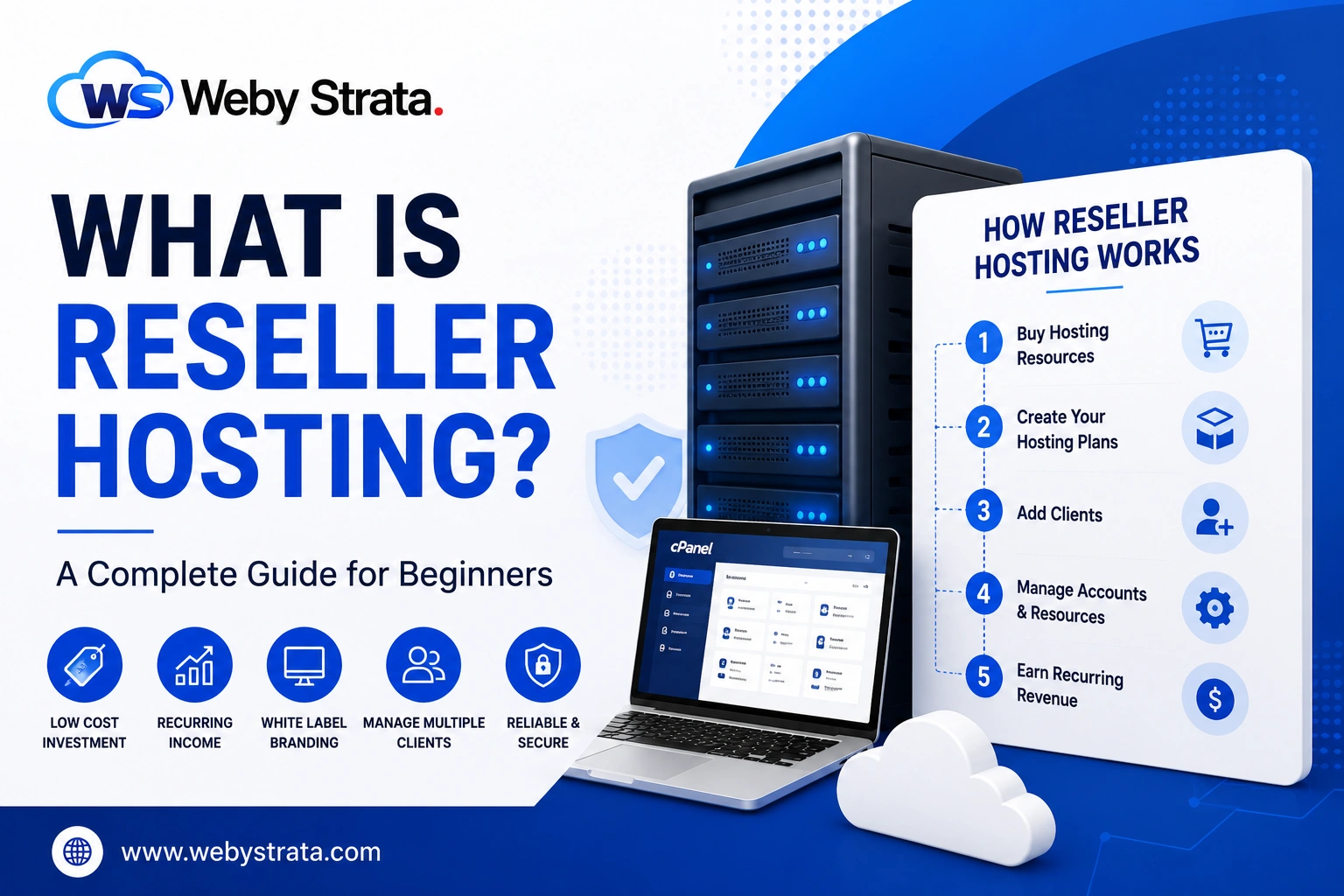
What Is Reseller Hosting?
If you have ever wanted to start your own web hosting business without investing in expensive servers and…
June 9, 2026